
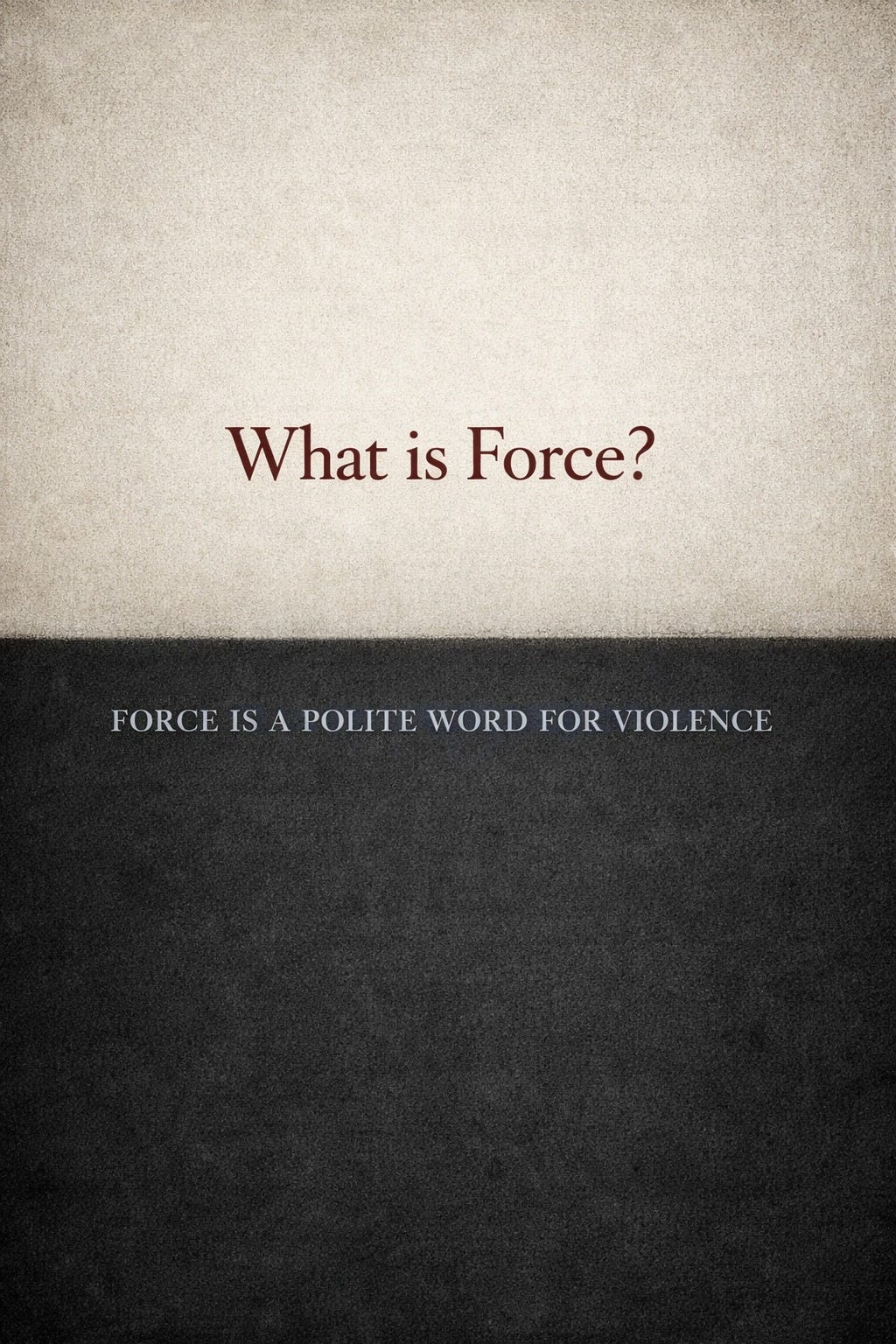
What is Force? — Force is a Polite Word for Violence
Force is a Polite Word for Violence

Preamble: Force and the Problem of Terminology
On Definitions, Evasion and the Abuse of Abstraction
One of the first objections raised whenever the role of violence in capitalism or the state is discussed is a familiar philosophical question:
“What do you mean by force?”
I heard this question repeatedly throughout my undergraduate education. It is usually posed as a demand for rigor. It was also a reminder that philosophy requires clarity, precision and careful definition of terms. In principle, this is a reasonable demand. Definitions are important. Words and terms are even more important.
But there is a problem.
In philosophy—and especially in political philosophy—abstraction often becomes a refuge. Terms that should be immediately intelligible are parsed, subdivided and refined until their meaning dissolves. What begins as clarification ends as evasion. The word force is a prime example.
Force is a word that behaves well in public.
It appears in legal documents, diplomatic briefings, corporate language and academic prose. It is used to describe “use of force,” “law enforcement,” “market forces,” “task forces” and “security forces.” The word carries weight without blood. It suggests inevitability rather than injury.
Violence, by contrast, is harder to civilize.
Violence is concrete. It breaks bones. It leaves bodies displaced, silenced, restrained or dead. Violence cannot be discussed indefinitely without moral discomfort. Force can. That distinction is not semantic; it is political.
When force is blatant—when people are dragged from homes, beaten, jailed or killed—no one is confused about what is occurring. But when that same violence is mediated through institutions, procedures, uniforms or law, suddenly the word becomes “slippery.” We are told we must slow down, qualify, distinguish and minutely refine.
This book rejects that evasion.
If we are going to take the problem of definition seriously, then we must do so consistently across dictionaries, legal doctrine, philosophy and historical practice. If force is real, it must retain its meaning when it appears as policing, eviction, imprisonment, conscription, taxation enforced by penalty or the exclusion of people from land and resources under threat of punishment. I am not opposed to defining terms. On the contrary: if the debate is about definitions, then let us finally define them exhaustively.
So we will do exactly that.
We will consult standard dictionaries; legal dictionaries; political theory; the historical record of how property, law and how states have actually operated. And when we do, one fact becomes unavoidable: Force, in the context of the state and capitalism, refers to violence—either directly applied or structurally enforced—and to the threat of that violence being applied. Calling it force rather than violence does not change its nature. It changes only its presentation. Capitalism does not merely emerge from markets or contracts. It requires a state. The state enforces property laws and contractual obligations for owners. That enforcement ultimately rests on coercion: fines, seizure, detention, imprisonment and, when necessary, lethal force.
To pretend otherwise is not philosophical rigor. It is terminological laundering.
This book does not split hairs where blood, bars and boots are involved. Where violence has been historically and systematically exercised by one group against others—to seize land, exclude people, discipline labor and maintain ownership—we do not need finer distinctions to obscure what is already clear.
Nevertheless, since the demand is always made, we will indulge it.
We will define force.
And once defined honestly, we will follow it wherever it leads. The insistence on definition is not misplaced. The problem lies in what definition reveals and what it conceals.
The Demand for Definition
Philosophy begins with definitions. Political life, however, often survives by avoiding them. Few words illustrate this tension more clearly than the term force. In everyday discourse, the word appears neutral, administrative and even necessary. Governments speak of the use of force; courts authorize force; police are permitted to apply reasonable force. The term circulates widely without provoking immediate moral alarm. Yet when examined closely, the word conceals a profound ambiguity. What precisely distinguishes force from violence?
The philosophical tradition insists that clarity precede argument. To discuss authority, law or political obligation without defining the operative terms risks confusion at best and intellectual evasion at worst. When citizens are detained, dispossessed, imprisoned or killed under institutional authority, observers rarely describe these acts as violence. Instead, they are described as enforcement, compliance or lawful force. The linguistic shift is subtle but consequential. It transforms an act that might otherwise provoke moral scrutiny into one that appears procedural and legitimate.
The difficulty, therefore, is not that force lacks definition but that its definition has become obscured by abstraction. Philosophers frequently warn against imprecision, yet excessive refinement can produce its own distortion. When concepts are parsed endlessly, their experiential meaning evaporates. The result is a peculiar inversion: the more technical the language becomes, the less recognizable reality appears. One risks, as the old critique of Christ warned, “straining at gnats while swallowing camels.”¹
This volume accepts the philosophical challenge rather than evading it. If force is invoked as the foundation of political order then the term must be examined across the domains that claim authority over it: language, law and history. Only by returning to these sources can we determine whether force genuinely differs from violence or whether it represents violence transformed by legitimacy.
Dictionary, Law and History
A survey of ordinary language provides an instructive starting point. Standard dictionaries define force as power exerted upon a person or object, compulsion applied against resistance or coercion used to secure compliance.² Even in neutral lexical form, force retains unmistakable proximity to violence. The distinction lies not in the absence of coercion but in the manner of its presentation.
Legal definitions sharpen the issue further. Modern jurisprudence distinguishes among reasonable force, necessary force, excessive force and deadly force. The law does not deny violence; it regulates who may employ it and under what conditions. Courts authorize officers to restrain, detain or even kill under certain circumstances, provided procedural standards are satisfied. Violence thereby becomes juridically categorized rather than abolished.³ What changes is not the act itself but the authority under which it is performed.
Historical usage reveals an even deeper transformation. Earlier political orders spoke openly of conquest, subjugation and domination. Empires expanded through warfare, rulers extracted tribute and authority rested upon demonstrable superiority of arms. Over centuries, however, the vocabulary shifted. Conquest became administration; domination became governance and tribute became taxation. Political violence did not vanish but migrated into institutional language.⁴
The emergence of the modern state crystallized this transformation. Max Weber’s influential formulation described the state as the entity claiming a monopoly on the legitimate use of physical force within a territory.⁵ The crucial term in Weber’s definition is legitimacy. Violence persists, yet it appears morally filtered through law and procedure. Force thus emerges as violence rendered acceptable through institutional recognition.
Etymological Note — Force and Violence
Modern discussions often treat force and violence as interchangeable terms. Historically and linguistically, however, they diverge in revealing ways. The English word force derives from the Latin fortis, meaning strong, powerful or effective. Through Old French (force), the term came to signify capacity, strength or power brought to bear. In its earliest usage, force did not necessarily imply injury. It described the ability to compel motion or produce an effect.
Force originally meant power or strength applied.
The word violence, by contrast, comes from Latin violentia, rooted in vis meaning force, energy or physical power. Yet violentia already carried a moral charge in Roman usage: it referred to force exceeding rightful bounds, power acting with excess, fury or violation.
Violence meant force experienced as harm.
This linguistic split allowed later societies to perform an important conceptual maneuver. Actions framed as necessary, lawful or institutional could be described as force, while the same physical acts, when condemned or unauthorized, could be labeled violence.
Thus language created a distinction between:
force as legitimate power
violence as illegitimate power
But materially, the difference often lies not in the action itself but in authority and perspective. For example, a state uses force and a criminal commits violence or an insurgent resists with violence but a government restores order through force.
The body struck experiences impact regardless of terminology.
Etymology reveals what political language frequently obscures: force and violence share a common origin. One term preserves respectability and the other preserves moral discomfort.
To study force honestly requires remembering that every system of order ultimately rests upon the controlled application of power capable of becoming violence. So then the question is never whether force exists but rather the question is who names it and who must endure it.
Threat and Use
Force operates less through constant action than through anticipated possibility. Violence need not be continuously enacted for force to remain effective. Compliance arises because individuals understand escalation is available should resistance occur. Citizens pay taxes not because armed agents stand beside them at all times but because they understand the chain of escalation and that refusal ultimately invites enforcement. Tenants vacate property after receiving legal notice because they recognize the chain of authority leading toward eviction by officers empowered to compel removal.
Force therefore exists prior to its application. It functions as latent violence; it is an ever-present capacity embedded within institutional systems. Violence is episodic; force is continuous. The threat suffices where repeated physical confrontation would prove destabilizing or inefficient. Political order depends less upon perpetual brutality than upon widely shared recognition that coercion remains possible.⁶
This insight marks a decisive shift in understanding. Violence appears as event, spectacle and rupture. Force, by contrast, becomes structure. It is woven into everyday life, operating quietly through expectations, regulations and legal obligations. Individuals encounter force not as dramatic confrontation but as ordinary compliance.
Degrees of Violence
Once force is understood as institutionalized violence, distinctions between violent acts reveal themselves as differences of degree rather than kind. Political societies maintain a spectrum of coercion extending from administrative penalties to lethal enforcement. At one end lie fines, fees and regulatory sanctions. These forms of compulsion are often treated as routine. Yet these measures derive authority from an underlying capacity for escalation. Persistent refusal transforms financial penalty into seizure of assets, arrest, imprisonment and ultimately physical restraint.
Hard violence—warfare, execution and incarceration—appears exceptional precisely because softer forms of coercion usually secure obedience beforehand. The bureaucratic order functions effectively when individuals comply at early stages of the spectrum. What appears benign remains connected, through institutional continuity, to the most severe applications of force.⁷
Understanding degrees of violence dissolves the illusion that modern societies have transcended coercion. Rather, they have distributed it across layers of administration, allowing enforcement to operate incrementally. Violence becomes procedural rather than spectacular.
The Besieging Condition
Modern political life unfolds within what may be called a besieging condition. Force no longer appears solely at moments of crisis; it becomes the ambient condition of political life. Property boundaries, contractual obligations, regulatory frameworks, surveillance systems and national borders collectively form a network of enforceable limits. Individuals navigate daily life within systems sustained by the possibility of compelled compliance.
This condition does not require constant confrontation. Its effectiveness lies precisely in its normalization. The modern citizen experiences force as background reality rather than extraordinary intrusion. Governance replaces conquest; administration replaces occupation and legitimacy replaces overt domination. Yet beneath these transformations remains the same foundational principle: exclusion backed by enforceable power.
Once defined, force ceases to be mysterious. It becomes historical.
Thesis Definition of Force
Force, then, may be defined as violence abstracted from the act, legitimized through law and embedded within institutional systems of enforcement. Recognizing this transformation neither glorifies nor condemns particular actors. It restores historical context to institutions that present themselves as natural or inevitable. Once force is understood in this manner, a new question arises that propels the inquiry forward: how did political order come to rest upon such a structure?
The answer leads backward, beyond governance and law, toward conquest itself.
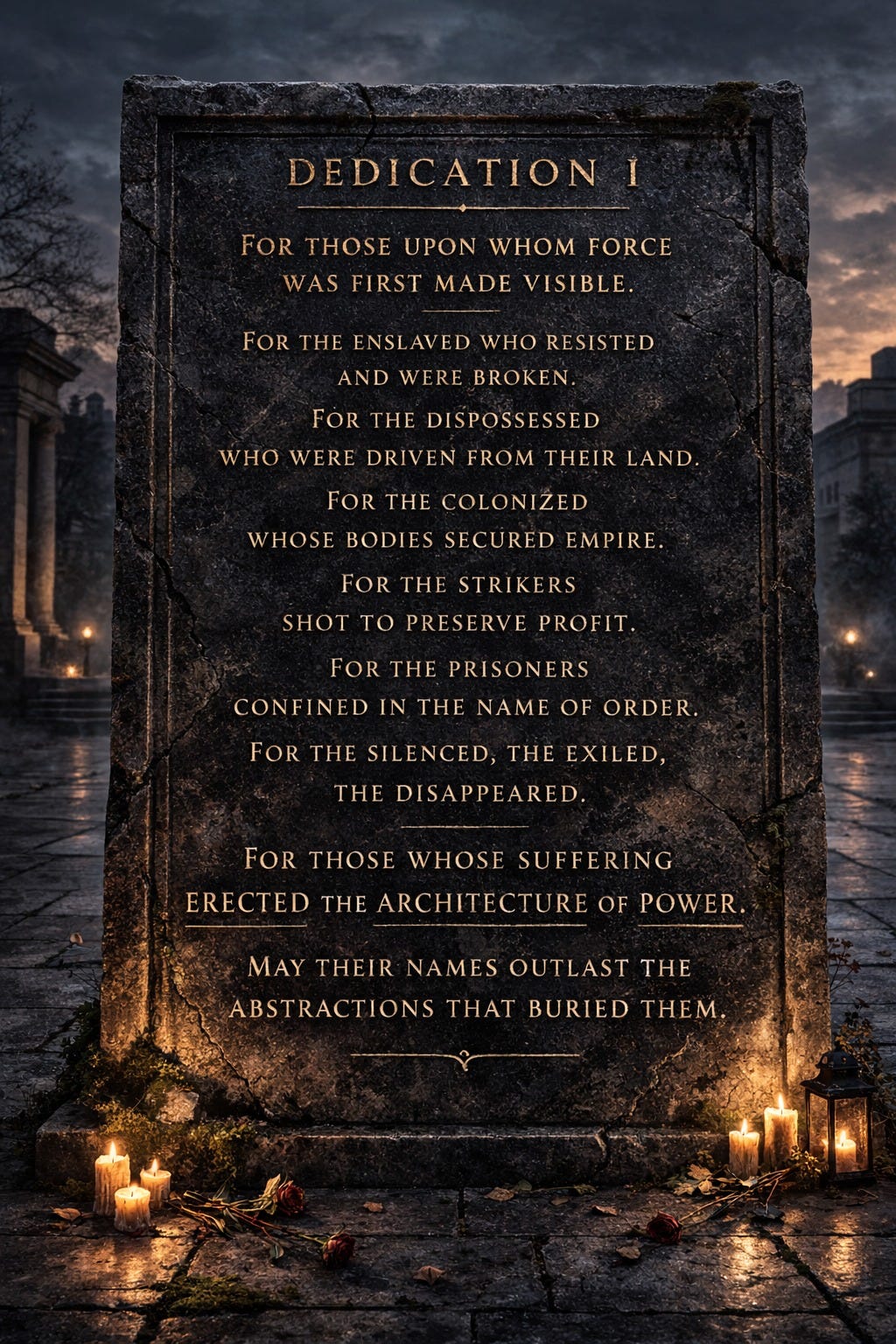
Force Dedication I
To Those Who Bore the Weight of Force
For those who stood against oppression and bore the consequences.
For those harmed by enforcement while resisting or enduring it.
More precisely:
Those killed while resisting dispossession.
Those imprisoned for organizing.
Those beaten for striking.
Those shot at protests.
Those disappeared by state power.
Those maimed in prison.
Those executed under local regimes.
Those crushed under legal regimes.
Those whose names were erased.
To those who were silenced and buried.
To those who refused to disappear quietly.
This volume is dedicated to those who stood in the path of power and felt its weight.
This is for you.
Bibliography:
Matthew 23:24 (King James Version).
Oxford English Dictionary, s.v. “force.”
Joshua Dressler, Understanding Criminal Law, 8th ed. (Durham, NC: Carolina Academic Press, 2018).
Norbert Elias, The Civilizing Process (Oxford: Blackwell, 2000).
Max Weber, “Politics as a Vocation,” in From Max Weber: Essays in Sociology, ed. H. H. Gerth and C. Wright Mills (New York: Oxford University Press, 1946).
Michel Foucault, Discipline and Punish (New York: Vintage Books, 1977).
Hannah Arendt, On Violence (New York: Harcourt Brace, 1970).
© 2026 Ben Eicher. All rights reserved. Reproduction or distribution without written permission is prohibited.