
Mode III: Force as Suppression — When Management Gives Way to Concentrated Force

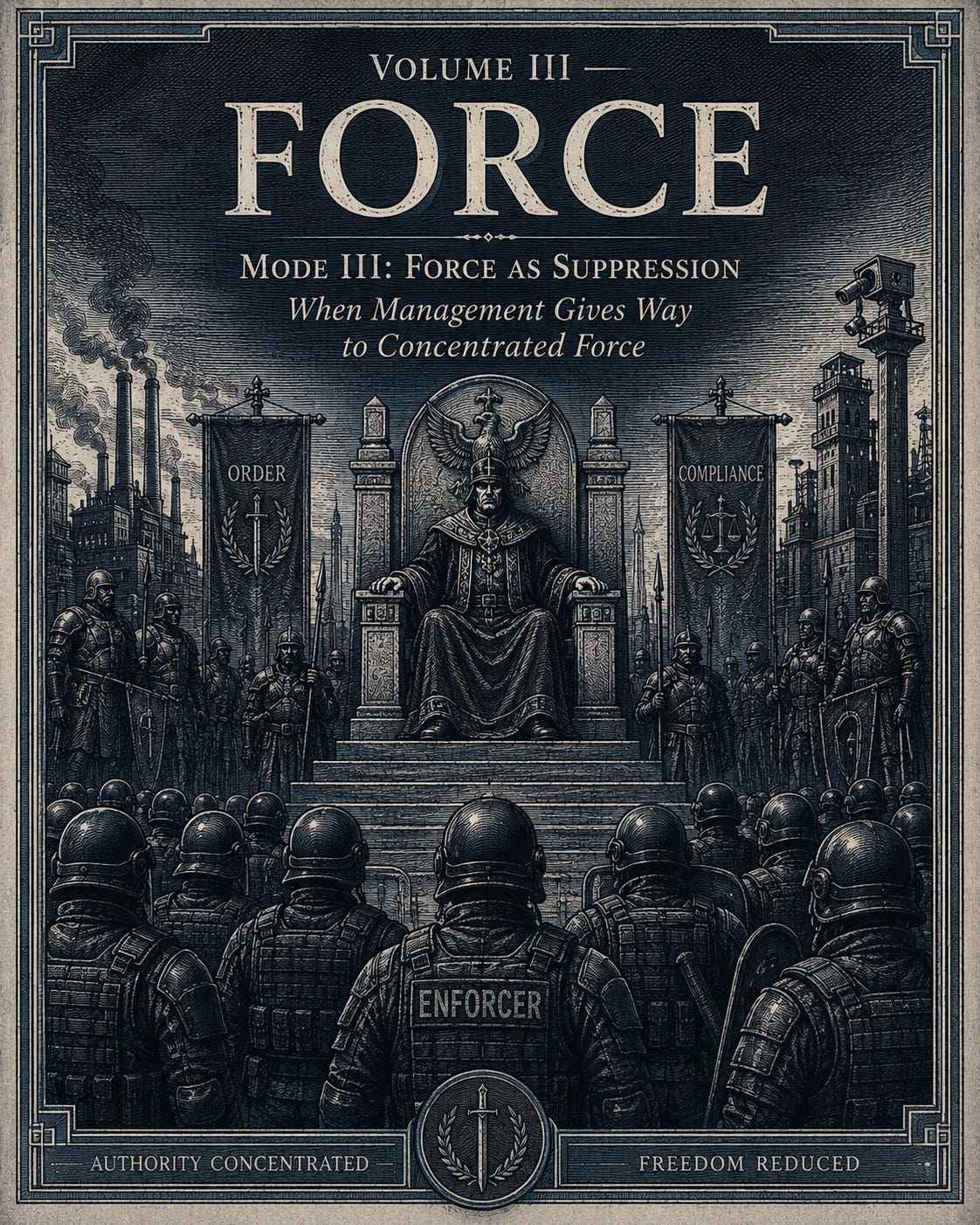
“The sovereign is he who decides on the exception.”
— Carl Schmitt, Political Theology, 19221
“At the moment when the crisis becomes acute and the usual forms of domination no longer work, force appears in its nakedness.” — Antonio Gramsci, Selections from the Prison Notebooks, 1929–19352
“Colonial violence does not only aim at keeping these enslaved men at arm’s length; it seeks to dehumanize them. Everything will be done to wipe out their traditions, to substitute our language for theirs and to destroy their culture.” — Frantz Fanon, The Wretched of the Earth, 19613
“The prison is not a place where society deposits its garbage. It is a place where society buries its contradictions.” — Angela Y. Davis, Are Prisons Obsolete?, 20034
Prologue — The Threshold
Force does not always announce itself.
The preceding chapters have traced its maturation through forms that are specifically designed not to announce themselves. This has been evidenced by the wall that presents itself as architecture; the census that presents itself as administration; the law that presents itself as justice; the police that presents itself as public safety and the market that presents itself as freedom. In each case, force has been the ground beneath the presentation—real, operative and consequential—but managed into a form that does not require constant visibility to function. The genius of managed force is precisely this: it produces compliance without announcing coercion, extracts without displaying the extraction apparatus and makes the conditions of domination feel, to enough of the governed enough of the time, like the natural conditions of organized social life.5
But no managed order is entirely secure. The conditions of compliance are not self-generating. They must be produced and reproduced and the production process is neither frictionless nor guaranteed. In the real world dynamics labor resists, communities organize and populations refuse. The legitimizing ideology wears thin under the pressure of experience that it cannot adequately explain. The debt that was supposed to produce docility produces instead the consciousness of structural dispossession. The legal system that was supposed to produce the experience of justice produces instead the experience of its systematic denial. The market that was supposed to produce prosperity produces instead the concentrated wealth of the few and the spreading precarity of the many. And when the managed order’s mechanisms of consent and compliance prove insufficient to maintain the conditions it requires, force reconcentrates.6
This is the threshold of suppression. It is not a departure from the logic of managed force— nor an aberration, nor a failure and not a last resort reluctantly deployed—but the continuation of that logic under conditions of strain. Suppression is management intensified. It is force returning to visibility because the invisible forms have been insufficient. It is the order defending itself. However, not against external enemies but—as in England orignally in early capitalism—against the populations whose compliance it requires and whose resistance it cannot, at the moment of suppression, fully manage through the quieter instruments that ordinarily suffice.7
The word itself encodes the argument. Suppress from Latin supprimere: to press down, to keep under, from sub (under) + premere (to press). The suppressed thing is not eliminated; it is pressed down, held beneath, kept from rising. Suppression is the continuous application of downward force against something that would otherwise rise. It is the ongoing maintenance of a condition of subordination against the tendency of the subordinated to move upward toward the surface of political life. The word names not a single act but a sustained operation.8
Mode III examines that sustained operation across three primary institutional forms: the military in its domestic and imperial suppressive functions, the surveillance apparatus that anticipates and maps resistance before it fully forms and the prison as the carceral architecture of containment and social removal. These three are not separate systems that happen to converge in moments of crisis. They are the integrated suppressive apparatus of the state-capital order where each is performing a specific function in the division of suppressive labor, each reinforcing and enabling the others, together constituting the harder edge of the managed order that Mode II traced in its quieter forms.9
If Mode II showed how force becomes ordinary, Mode III shows what the ordinary is protecting.
Suppression as Continuation — The Logic of Intensification
The most important thing to establish about suppression is what it is not.
It is not a failure of management. Although, the standard liberal account of state violence presents it as a departure from the norm of managed order. It is presented as if it is an excess, a malfunction or the state acting badly in ways that its better principles would prohibit. This account serves a specific ideological function: it insulates the normal from the exceptional, presenting the violence of the prison, the military deployment and the surveillance apparatus as deviations from a political order that is, at its core, oriented toward the peaceful management of collective life. If the violence is exceptional then the normal can remain innocent.10
This account is false in the precise sense that it inverts the actual relationship. Suppression is not the exception that proves the rule of peaceful management. It is the rule in concentrated form; it is the same logic of organized force operating at higher intensity and with less institutional concealment. The managed order does not become something else when it suppresses. It reveals what it has always been.11
Antonio Gramsci’s analysis of the relationship between hegemony and coercion is the most precise available framework for understanding this relationship.12 Gramsci argued that the dominant class maintains its rule through two complementary mechanisms: hegemony as the production of consent through the naturalization of its values and worldview as common sense and coercion as the direct application of force when hegemony is insufficient or unavailable. These are not separate systems operating independently of each other. They are the two poles of a single continuum and every stable political order operates somewhere between them, relying more heavily on hegemony in periods of stability and more heavily on coercion in periods of crisis. Mode II is the hegemonic pole. Mode III is the coercive pole. The order is the same; only the mix has changed.13
Walter Benjamin’s analysis of the two forms of violence that constitute the legal order provides the philosophical complement to Gramsci’s political analysis.14 Law-making violence is the violence that establishes the order: the founding act of seizure and conquest that Mode I traced. Law-preserving violence is the violence that maintains the order: the police, the courts, the prisons and the military that Mode II and Mode III trace. Both forms are constitutive of the legal order; neither is external to it. But Benjamin identified a third possibility—divine or pure violence—that stands outside both forms, that neither founds nor preserves law but abolishes it, that represents the possibility of a break with the order that both law-making and law-preserving violence constitute.15 The suppressive apparatus of Mode III is, among other things, the legal order’s defense against this third possibility and against the emergence of a force that would neither found nor preserve the existing law but replace it entirely. Suppression is law-preserving violence at high intensity, called forward by the perceived threat of something that would dissolve the law itself.
Carl Schmitt’s analysis of the exception adds a further dimension.16 The sovereign is defined not by the normal operation of the legal order but by the capacity to suspend it and to declare the exception in which the ordinary rules do not apply. The state of exception is not the opposite of the legal order. It is the legal order’s innermost possibility, the expression of sovereignty in its most concentrated form. Every act of suppression invokes, explicitly or implicitly, the sovereign’s power of exception: the authority to suspend the protections that the legal order normally provides to its subjects in the name of the order’s defense. The curfew, the no-fly zone, the military deployment in a domestic space and the preemptive detention of suspected dissidents are all exercises of the exception that Schmitt identified as sovereignty’s foundational act.17
Giorgio Agamben’s extension of Schmitt’s analysis into the contemporary period is the most disturbing available account of what happens when the exception becomes permanent.18 When the state of emergency is extended indefinitely—when the suspension of normal legal protections becomes the standing condition rather than a temporary measure—the exception ceases to be an exception and becomes the rule. The camp—the space in which the sovereign’s power is exercised without the constraints of the normal legal order—is, for Agamben, the paradigmatic institution of modern sovereignty: not an extreme aberration but the truth of what the legal order rests on, made visible. The Guantanamo detention facility, the indefinite immigration detention center, the no-fly list without judicial review are the camp in its contemporary expressions: the permanent state of exception that the permanent security state has made the standing condition of a specific category of persons who exist inside the legal order but outside its protections.19
The Military Returns — Reserve Force in Domestic Operation
Military power first appeared in this volume in Chapter 1 as the founding force of seizure: the warband, the raid and the conquest that established the conditions from which the state eventually grew. It appeared again in Historical Ligament II as the institutional apparatus that matured alongside and enabled every other form of managed power. Here, in Mode III, it appears for the third time in a different form and under different conditions but continuous with both its earlier appearances in ways that Mode III’s argument requires to be made explicit.20
The military in its suppressive function is not the warband and not the imperial army. It is the standing reserve of organized lethal force that the state maintains permanently, available for deployment at the moment when the other forms of managed order prove insufficient. Its primary suppressive function in the mature capitalist state is not military in the conventional sense. Nor is it the confrontation of external enemies on foreign soil, though that function remains available and regularly exercised. It is the management of the conditions of domestic order at the limit of what the police and administrative apparatus can maintain. Therefore, it is the backing that makes all other backing credible.21
The National Guard deployment against labor strikes in the American industrial period is the domestic military suppression function in its most historically transparent form. Between 1877 and 1937, American military and National Guard forces were deployed against labor actions in the railroad industry, the steel industry, the mining industry, the textile industry and virtually every other sector of industrial production in which workers organized effectively enough to disrupt the employer’s capacity to operate. The deployment was not occasional or reluctant. It was systematic and it was a standard instrument of labor relations in which the employer’s right to operate was backed by the state’s military capacity, making the worker’s right to withhold labor contestable by organized armed force.22
The domestic military suppression function in its contemporary form is less visible than the industrial period’s deployments precisely because it has been more thoroughly institutionalized. The militarization of the police— the transfer of military equipment, military training, military doctrine and military organizational culture to civilian police departments—has converted the police into a domestic military force for most suppressive purposes, reducing the need for explicit military deployment while achieving the same organizational and tactical capacity.23 The SWAT team, the armored personnel carrier, the flash-bang grenade, the long-range acoustic device, the military-style body armor worn by officers managing protest crowds are the military’s domestic suppressive function, transferred to the police in a form that maintains the civilian appearance of the institution while equipping it for military operation.
The 1033 Program—through which the Department of Defense transfers surplus military equipment to local law enforcement agencies at no cost—is the institutional mechanism of this transfer.24 By 2014, over $4.3 billion in military equipment had been transferred to civilian police departments through this program, including Mine-Resistant Ambush Protected vehicles designed for use in Iraq and Afghanistan, military-grade assault rifles, grenade launchers and surveillance equipment. The program transferred not only equipment but the organizational logic that accompanied it: the logic of counterinsurgency, of threat assessment, of the management of a potentially hostile population in an occupied territory. The domestic police department that received the equipment also received the conceptual framework in which the civilian population becomes a terrain to be managed through military-style suppression rather than a community to be served through civilian law enforcement.25
The imperial military function is the suppressive apparatus operating at its global scale. It is the projection of American military power across approximately eight hundred bases in more than seventy countries. It is the naval capacity to control sea lanes and chokepoints. It is the drone program that allows lethal force to be projected anywhere on earth without the legal constraints that would apply to operations within the United States, the Special Operations Command that conducts missions in dozens of countries simultaneously without the visibility that conventional military deployment would require.26 David Harvey’s analysis of the new imperialism frames this global apparatus as accumulation by dispossession at scale. Here, it is the military securing the conditions of capitalist extraction in regions where the normal mechanisms of market discipline and legal enforcement are insufficient to maintain the conditions of accumulation.27 The drone strike and the structural adjustment program are different instruments of the same strategy: the management of peripheral populations and resource territories in the interest of capital’s global circulation, with the military providing the force that the market cannot provide through its ordinary operations.
The Surveillance Apparatus — Seeing Before Striking
Suppression does not begin with force. It begins with vision.
The surveillance apparatus—the integrated system of cameras, databases, communication intercepts, algorithmic analysis, behavioral profiling and predictive assessment that constitutes the contemporary security state— is suppression’s informational infrastructure: the means by which the order sees its population before it acts on what it sees, maps the terrain of potential resistance before it becomes actual resistance and identifies the persons and organizations whose suppression is required before they have done anything that suppression could plausibly claim to be responding to.28
This anticipatory character is the surveillance apparatus’s defining feature and its most politically significant one. The watch was anticipatory from the beginning—as the police history traced in Historical Ligament I established, the watchman patrolled the threshold between normality and disturbance, concerned with presence and movement rather than only with crime after the fact. Contemporary surveillance extends this logic to its extreme: the aim is not to see what has happened but to see what will happen. The goal is to achieve the predictive knowledge of the population’s behavior that would make suppressive intervention preventive rather than reactive.29
Michel Foucault’s analysis of security mechanisms as fundamentally different from disciplinary mechanisms is the theoretical framework for understanding this distinction.30 Discipline works on the individual body; it observes, corrects and normalizes. Security works on the population as a statistical entity; it identifies distributions, manages risks and intervenes at the population level rather than the individual level. The surveillance apparatus of the contemporary security state is a security mechanism in Foucault’s sense: it does not primarily aim to discipline individual persons but to manage the population’s distribution of behaviors, identifying statistical anomalies that suggest the emergence of risk and intervening to manage those risks before they manifest as events.31
The NSA mass surveillance program revealed by Edward Snowden in 2013 is the most comprehensively documented expression of the security apparatus in its contemporary form.32 The program collected the communication metadata of every American with a telephone or internet connection. It was not the content of communications but the pattern of communications: who called whom, when, for how long, from where and with what frequency. The metadata, subjected to algorithmic analysis, produces a behavioral map of the population that allows the identification of persons whose communication patterns deviate from statistical norms in ways the algorithms have been trained to associate with risk. The individual who appears on this map is not accused of an offense. They have been flagged by a statistical analysis of their behavior as exhibiting patterns that the security apparatus associates with the preconditions of offense.33
This is the predictive policing logic applied at national scale and it represents a qualitative transformation of the relationship between the state’s surveillance capacity and the legal rights of its subjects. The legal presumption of innocence applies to persons who are accused of an offense. It does not straightforwardly apply to persons who have been flagged by algorithmic analysis as statistically associated with risk. The legal architecture of rights and protections was designed for a surveillance apparatus that observed behavior and acted on what it observed. It was not designed for a surveillance apparatus that predicts behavior and acts on the prediction. The security state has outrun the legal framework that was supposed to constrain it.34
Zuboff’s analysis of surveillance capitalism—the extraction of behavioral data from the population not for security purposes but for commercial ones, by the platform corporations whose services constitute the infrastructure of contemporary daily life—adds the dimension of private surveillance to the state apparatus.35 The smartphone that tracks location, the social media platform that records every interaction, the search engine that maps every inquiry, the loyalty card that documents every purchase. These are surveillance instruments operated by private corporations in service of commercial interests but they produce behavioral data that the state security apparatus can and does access through legal process or extralegal arrangement. The distinction between public and private surveillance has been substantially dissolved by the architecture of the data economy: the state can see what the platforms see, and the platforms see everything.36
The COINTELPRO program—the FBI’s systematic surveillance, infiltration, disruption and destruction of political organizations deemed threatening to the existing order, operating from 1956 to 1971—is the most thoroughly documented historical example of surveillance as suppression rather than mere observation.37 The program targeted the Communist Party, the Socialist Workers Party, the Puerto Rican independence movement, the American Indian Movement and most consequentially the civil rights movement and the Black liberation movement. Their activities included the specific targeting of Martin Luther King Jr., whose surveillance file documented not only his public activities but his private life and was used to generate material for a blackmail letter that the FBI sent anonymously urging him to kill himself.38 The program’s targets were not criminals. They were political organizations whose goals—racial equality, labor rights and national self-determination—threatened the existing property and power arrangements that the security apparatus was designed to protect. COINTELPRO shows what the surveillance apparatus is for when the hegemonic order feels sufficiently threatened: not the prevention of crime but the prevention of political transformation.39
The Prison — Containment as System
The prison is the suppressive apparatus’s institution of last resort in the sense that it receives those whom the other instruments have failed to manage. It is for those who have been surveilled and still acted, policed and still resisted, legally processed and still remained threats to the order’s requirement for their compliance. But it is also, in another sense, the suppressive apparatus’s most comprehensive institution: the space in which the state’s power over persons is most complete, most continuous and most unmediated by the ordinary legal protections that constrain state power in the civilian space outside the prison walls.40
The prison does not merely punish. In its contemporary form, as Angel Davis and Loic Wacquant have demonstrated with exhaustive documentation, it warehouses. It receives the surplus population that the managed capitalist order has rendered economically unnecessary, politically threatening or socially unmanageable and it holds that population outside the ordinary circuits of economic and social life while maintaining them fully inside the architecture of state power. The incarcerated person is not freed from the state’s administration. They are subjected to it in its most concentrated form where they are stripped of the rights that civilian legal status provides, subjected to the total institutional management of their daily life and converted from a political subject with claims on the order into an administered body that the order manages without political obligation.41
The scale of American incarceration is the most important empirical fact for understanding the contemporary prison’s suppressive function. The United States incarcerates approximately two million people—which is more than any other country in the world in absolute numbers and at a rate per capita exceeded only by a handful of authoritarian states.42 The racial composition of this incarcerated population is the second most important empirical fact: Black Americans are incarcerated at approximately five times the rate of white Americans and the incarceration rate for Black men specifically is so high that it constitutes what Michelle Alexander has called a new Jim Crow: a caste system enforced through the criminal justice apparatus that produces the civic death of the convicted, stripping them of voting rights, access to public housing and benefits and legal employment in ways that reproduce the social exclusion of the formally abolished racial order.43
Wacquant’s analysis of the relationship between the dismantling of the welfare state and the expansion of the carceral state—his argument that the same political moment that reduced social provision for the poor expanded the apparatus for their punishment—is the most analytically precise account of the prison’s suppressive function in the neoliberal period.44 The poor are not managed less when the welfare state is dismantled. They are managed differently—through criminalization rather than provision, through incarceration rather than support and through the penal apparatus rather than the social apparatus. The retraction of welfare and the expansion of prison are not contradictory policies. They are complementary instruments of the same governance strategy: the management of surplus population through punishment when management through support is no longer the preferred option.45
Incarcerate from Latin incarcerare: to imprison, from in (in) + carcer (prison, enclosure). Carcer is also the root of coerce through a cognate form and is the same root that names the prison names the coercive relationship more generally. The enclosure and the coercion share an ancestor. The prison is coercion made architectural. It is the enclosure of the body that makes the coercive relationship total, continuous and inescapable for the duration of the sentence. The prison walls do not merely contain. They are the coercive relationship made permanent in stone.46
The private prison—the for-profit corporation contracted by the state to manage the incarcerated population—is the prison’s suppressive function combined with the market logic of Mode II’s economic analysis.47 The private prison corporation has a financial interest in maintaining the incarcerated population at the level required to fill its facilities and maximize its revenue. It lobbies for legislation that increases incarceration rates, for mandatory minimum sentences that guarantee long stays and for immigration enforcement policies that produce detainees requiring housing. The prison industrial complex—Gilmore’s term for the integrated system of corporations, politicians, rural economies dependent on prison employment and legal machinery that sustains and expands mass incarceration—is suppression as business model: the conversion of poverty and racialized enforcement into a profit-generating system whose continuation depends on the continuous production of the population it claims to manage.48
Counterinsurgency and the Colonial Reflex
Suppression’s most intensive form—the form that most clearly reveals what the suppressive apparatus is for and whose interests it serves—is counterinsurgency: the organized military, police and administrative response to populations that have organized against the existing order in ways that the ordinary suppressive mechanisms cannot manage.49
The counterinsurgency doctrine is the military’s theory of suppression; its systematic analysis of how organized resistance forms, sustains itself and is defeated. In its contemporary American form, developed from the experience of the Iraq and Afghanistan occupations, counterinsurgency doctrine holds that military victory against an insurgency requires not merely the defeat of armed forces but the management of the population within which those forces operate. That is, the winning of hearts and minds, the provision of services, the construction of governance structures and the systematic identification and removal of the insurgency’s political and organizational leadership.50
What counterinsurgency doctrine does not acknowledge—what its official literature systematically obscures—is that the populations against which counterinsurgency is deployed are almost always populations whose insurgency is a response to the prior operations of the very order that counterinsurgency defends. The Iraqi population that resisted American occupation was resisting an occupation imposed through an invasion conducted in violation of international law on the basis of fabricated intelligence. The Afghan population that sustained twenty years of resistance against American forces was resisting the maintenance of a client regime by an outside power with interests antithetical to the population’s own. The colonial counterinsurgency is the response to the resistance that colonialism itself produced, It is the suppression of the reaction to the suppression.51
Frantz Fanon’s analysis captures this structure with a clarity that no subsequent treatment has surpassed.52 Colonial violence is not incidental to the colonial order. It is constitutive of it; the means by which the colonial order is established, maintained and reproduced. The colonized person’s experience of colonial power is primarily the experience of organized violence: the police checkpoint, the curfew, the pass system, the forced labor, the confiscation of land, the periodic massacre when resistance becomes organized. And the colonized person’s response to this experience—the violence of the anticolonial struggle—is not, for Fanon, a departure from the colonial order’s violence but its inevitable consequence: the colonial violence returning on the heads of those who inflicted it, transformed by the consciousness of the oppressed into a force for liberation rather than domination.53
The domestic counterinsurgency—the application of counterinsurgency doctrine and tactics to domestic political movements—is the colonial logic applied inward. The COINTELPRO program was domestic counterinsurgency before the term was current: the systematic identification of organizational leadership, the infiltration and disruption of organizational capacity, the discrediting of public figures, the engineering of internal conflict and the physical elimination of those deemed most dangerous to the order.54 The contemporary fusion of counterterrorism doctrine with the surveillance and policing of domestic political movements—the FBI’s designation of Black Lives Matter as a potential terrorist threat, the Department of Homeland Security’s monitoring of environmental activists and the Joint Terrorism Task Force’s investigation of labor organizers— is counterinsurgency logic applied to the management of domestic dissent: treating political opposition as an insurgency to be defeated rather than a democratic expression to be accommodated.55
Naomi Klein’s analysis of the shock doctrine—the systematic exploitation of social trauma, natural disaster and political crisis to advance the displacement of existing social arrangements with the preferred arrangements of capital—is the economic dimension of the counterinsurgency logic.56 The crisis that requires suppression also creates the conditions for the imposition of arrangements that could not be imposed under normal conditions. The population in shock—disoriented, afraid and dependent on emergency provision—is the population most available for the kind of rapid institutional transformation that capital requires and that democratic processes in stable conditions would prevent. Suppression and reconstruction are the military and economic arms of the same operation: suppress the resistance, then impose the arrangement that the resistance was preventing.
The Political Economy of Suppression
Suppression is not merely a political phenomenon. It has a political economy or a specific relationship to the requirements of capitalist accumulation that explains both its timing and its direction.57
The relationship is not simply that capital employs the suppressive apparatus to protect its interests, though it does that. It is much deeper: the suppressive apparatus is itself a sector of capitalist accumulation. It is an industry producing goods and services whose market is the state’s security budget, whose growth depends on the continuous production of threats requiring suppressive response and whose political influence shapes the production of those threats through the lobbying of the legislative and administrative process.58
The defense industry is the most familiar expression of this logic. Lockheed Martin, Raytheon, Boeing Defense, General Dynamics and their competitors produce weapons systems, surveillance technology, logistical infrastructure and intelligence systems whose market is the federal security budget. Their lobbying expenditures, their revolving-door personnel exchanges with the Department of Defense and intelligence agencies and their geographic distribution across Congressional districts—ensuring that the economic constituencies for defense spending are distributed across the maximum number of legislative districts—constitute the political infrastructure of the permanent security state.59
The prison industry is the domestic expression of the same logic. The private prison corporation, the bail bond industry, the ankle monitor manufacturer, the telephone company that extracts rents from incarcerated persons’ calls, the commissary provider that sells necessities at inflated prices to captive consumers — these are the economic ecosystem of mass incarceration, each with a financial stake in the continuation and expansion of the carceral system whose captive population constitutes their market.60
The surveillance industry—the technology corporations that produce the facial recognition systems, the predictive policing algorithms, the communication intercept infrastructure, and the database management systems that constitute the surveillance apparatus—is the most rapidly growing sector of the security-industrial complex, benefiting simultaneously from government contracts and from the commercial surveillance economy that the same technologies serve.61 Palantir, the data analytics corporation co-founded with CIA seed funding, is the paradigmatic institution of this convergence: a company that provides surveillance and data analysis services simultaneously to government security agencies and to commercial clients, whose business model depends on the continued expansion of both the security state and the commercial data economy, and whose political connections ensure that the regulatory environment remains favorable to both.62
Harvey’s analysis of accumulation by dispossession—his argument that contemporary capitalism maintains its growth through the conversion of previously non-commodified social spaces and relationships into market opportunities, backed by state and military force when the conversion meets resistance—provides the framework for understanding the political economy of suppression in its full scope.63 The enclosure of the digital commons through intellectual property law backed by criminal enforcement. The conversion of public land into extraction zones for fossil fuel companies backed by the suppression of indigenous and environmental resistance. The privatization of public services backed by the fiscal and police power of the state against the workers and communities who resist their loss. These are accumulation by dispossession in its contemporary forms and they require suppression precisely because they are the dispossession of communities from arrangements that benefit them, imposed in the interest of capital’s requirement for new spaces of accumulation.
The State of Exception and the Architecture of Bare Life
The state of exception—the suspension of the normal legal order in the name of the order’s defense—is suppression’s political-philosophical foundation. Every act of concentrated force by the state involves, explicitly or implicitly, a claim that the normal rules do not apply in this case because the order’s survival requires their suspension.64
Schmitt’s formulation—the sovereign is he who decides on the exception—names the fundamental structure of this claim.65 The exception is not defined by its content but by its source: it is whatever the sovereign declares to be outside the normal legal framework. The sovereign’s power of exception is therefore prior to and independent of the legal order — it is the power that makes law possible by being able to suspend it, that grounds the legal order by being its ungrounded ground. Every legal system rests on this sovereign capacity, which no legal system can fully absorb or constrain, because the constraint would itself be subject to suspension.
Agamben’s extension of Schmitt into the analysis of the camp—the spatial expression of the exception—is the most consequential philosophical analysis of suppression’s architectural form.66 The camp is the space in which the exception becomes spatial, where the sovereign’s power to suspend the legal order is given permanent physical form. In the camp, the normal protections of the legal order do not apply. The persons held there exist in a condition Agamben calls bare life or zoē rather than bios, the mere biological fact of existence stripped of the political qualifications that make one a subject of rights. The camp inmate is a person who has been reduced to bare life by the sovereign’s act of exception.
The contemporary expressions of the camp are not the historical examples of their most extreme form, though those remain instructively present in the historical record. They are the immigration detention center in which persons are held indefinitely without the legal procedures that criminal detention requires. The Guantanamo facility in which persons are held as “enemy combatants” outside the framework of either criminal law or the laws of war. The no-fly list on which persons are placed without notice, without hearing and without the legal process through which the listing could be challenged. The predictive detention program in which persons are held based on algorithmic assessment of future risk rather than past act.67
Each of these is the exception in its contemporary institutional form. This is the space or the administrative category in which the normal legal protections do not apply, in which the person has been reduced to a status below full legal personhood and in which the sovereign’s power is exercised without the constraints that law provides in the normal case. They are not aberrations from the legal order. They are the legal order’s exceptional dimension made permanent and routinized. It is the exception that has become the rule, the suspension that never lifts because the threat that justifies it is never definitively resolved.68
Karl Polanyi’s analysis of the double movement—the market’s tendency to generate resistance that requires political containment—names the dynamic that produces the permanent state of exception at the political-economic level.69 When the market’s reorganization of social life produces sufficient disruption—when it creates the dispossession, the insecurity and the political mobilization that its own operations generate—the political response takes the form of protective measures that restrain the market’s destructive tendencies. But when the protective measures threaten the conditions of accumulation, the suppressive apparatus is mobilized to defend those conditions against the protection. The permanent state of exception is the institutional form that emerges when the suppressive defense of market conditions becomes normalized. It is what happens when the exception required to break the double movement becomes the standing condition of governance.
Suppression as Revelation — What the Order Shows When It Is Afraid
Suppression is the managed order’s most honest moment. Not its best moment but its most honest one. It is the moment at which the institutional presentations that management requires—law as justice, governance as public service, the market as freedom and the police as protection—become insufficient to maintain compliance and the force that underlies all of them is briefly visible in its concentrated form.70
This revelation is politically significant for reasons that go beyond the immediate horror of suppressive violence. When the state deploys military force against striking workers or conducts mass surveillance of political organizations or incarcerates a generation of Black men through a racially selective enforcement of drug laws or indefinitely detains migrants without legal process, it shows what the order is protecting and from whom. The suppressive target is the answer to the question that management’s ordinary operations never quite answer: whose order is this, and who is it against?71
The answer that suppression gives is always the same, adjusted for the specific historical moment. It is the order of property against those who lack it. The order of racial hierarchy against those who challenge it. The order of capital against those whose labor it requires and whose political organization it fears. The order of the existing territorial arrangements against those whom those arrangements dispossess. Suppression does not create these contradictions. They are built into the managed order from its foundation in seizure, maintained through the extraction that Mode II traced and legitimized through the ideology that Volume II analyzed. But suppression makes them visible by acting on them directly, without the mediation of management’s more polished instruments.72
This visibility is suppression’s vulnerability as well as its function. The suppressive apparatus requires invisibility to operate most efficiently. This is the surveillance that is not known to be operating, the prison that is geographically and politically isolated from the mainstream of civic life and the military deployment that is classified or euphemized. When suppression is visible—when the police beating is filmed, when the incarceration rate statistics are published and when the leaked documents reveal the surveillance program—the legitimizing ideology that management requires is damaged. The claim that the order is neutral, that the law is just, that the governance is in everyone’s interest, is harder to sustain when the suppressive apparatus is operating in full public view.73
Guy Debord’s analysis of the spectacle—his argument that the dominant order maintains itself not only through material conditions but through the organization of appearances, the production of a visible reality that substitutes for genuine social life—is relevant here in an unexpected direction.74 The suppressive apparatus generates its own spectacle problem: the spectacle of suppression, when visible, contradicts the spectacle of management. The image of the police in riot gear facing unarmed protesters or the video of the drone strike or the photograph of the concentration camp, is a rupture in the managed appearance of the order. It is a moment when the underlying reality breaks through the surface of the presentation and the population is briefly confronted with what the order actually is and does.75
The management of the spectacle of suppression—the classification of drone strike casualties, the criminalization of recording police violence, the media management of prison conditions and the euphemization of counterinsurgency operations—is the suppressive apparatus’s communication strategy: the attempt to maintain the legitimizing presentation of the managed order while conducting the operations that the managed order’s maintenance requires. It does not always succeed. The spectacle ruptures. The image circulates. The revelation occurs. And in the moment of revelation, the managed order must decide whether to acknowledge what has been revealed or to suppress the revelation itself, which is, typically, what it does.76
The Circle and What It Protects
Mode III closes the argument of Volume III’s middle movement. It is not the argument of the entire volume, which continues through the later chapters but the argument about what force becomes as it matures through seizure, management and the transition to concentrated defense.
The circle that Mode III closes is the circle from warband to suppression. It started and moved from the personal, mobile, predatory force of Chapter 1 through the institutionalized, distributed, managerial force of Mode II and finally to the concentrated, defensive, revelatory force of Mode III. The circle is not a cycle of repetition. It is a spiral where each turn at a higher level of institutional development, greater organizational complexity and more complete legitimizing apparatus but organized around the same foundational operation: the maintenance of the conditions under which the seizure that Mode I traced can continue to generate the surplus that Mode II manages and that Mode III defends.77
The military secures those conditions at their global scale by projecting force to the chokepoints, the resource frontiers, the subordinate regimes whose compliance capital’s global circulation requires. The surveillance apparatus maps the population whose potential resistance would disrupt those conditions by seeing before striking, anticipating before acting and converting the future into a risk to be managed rather than a possibility to be allowed. The prison stores the population that the other instruments have failed to manage by containing the surplus, the resistant, the politically organized and the socially unregenerate in the space of bare life outside the ordinary circuits of civic existence.78
Together, these three institutions constitute what Charles Tilly called the coercion-intensive state: the state in which the primary mechanism of order is the organized application of force rather than the production of consent.79 In the mature capitalist state, the coercion-intensive and the capital-intensive modes are not separate systems. They are the suppressive and the managerial faces of the same order: This means force is concentrated when management is insufficient and force is distributed when suppression is unnecessary. The order moves between these faces continuously, calibrating the mixture according to the specific requirements of the specific moment, never fully abandoning either.
What Mode III reveals—what suppression always reveals—is that the managed order is not what it presents itself as. It is not the natural expression of the political animal’s social nature. It is not the neutral administration of the common interest. It is not the rational organization of collective life for collective benefit. It is the defense of a specific distribution of property, power and life chances against the challenge that the people at the bottom of that distribution—the dispossessed, the exploited, the surplus and the resistant—perpetually represent.80
This defense is not always violent. It is usually not violent. The genius of management is precisely that it makes the defense mostly invisible because it is embedded in procedure, in law, in market discipline, and ultimately in the normalized expectation that this is simply how things are. But when management is insufficient, the defense becomes visible. It can be seen when the military deploys; when the surveillance apparatus activates; when the prison fills and the order shows what it has always been: a specific arrangement of force, protecting specific interests, against specific people who would change it if they could.
Mode III is not a departure from the argument. It is how the argument made impossible to ignore. If Mode I showed how force begins and Mode II showed how force endures, Mode III shows what force is ultimately for.81
Bibliography
Carl Schmitt, Political Theology: Four Chapters on the Concept of Sovereignty, trans. George Schwab (Chicago: University of Chicago Press, 1985), 5. Schmitt’s formulation is deployed here not as endorsement but as the most precise available statement of the relationship between sovereignty and the exception — the founding theoretical premise of the suppression analysis that follows.
Antonio Gramsci, Selections from the Prison Notebooks, ed. and trans. Quintin Hoare and Geoffrey Nowell Smith (New York: International Publishers, 1971), 210. The epigraph captures Gramsci’s analysis of the relationship between hegemony and coercion — the moment when the usual forms of ideological domination prove insufficient and naked force returns to visibility.
Frantz Fanon, The Wretched of the Earth, trans. Richard Philcox (New York: Grove Press, 2004), 5. Fanon’s analysis of colonial violence as constitutive rather than aberrational is foundational to the counterinsurgency section and the essay’s argument about suppression as revelation.
Angela Y. Davis, Are Prisons Obsolete? (New York: Seven Stories Press, 2003), 15. Davis’s formulation captures the essay’s central argument about the prison’s suppressive function — its role in managing social contradictions rather than responding to individual wrongdoing.
On the genius of managed force as the production of compliance without announcing coercion, see the Mode II essay in this volume, particularly the analysis of the five expressions of management. On the conditions of compliance as requiring continuous production and reproduction, see Gramsci, Selections from the Prison Notebooks, 12–23.
On the conditions under which the managed order’s mechanisms of consent and compliance prove insufficient, see Walter Benjamin, “Critique of Violence,” in Selected Writings, Volume 1: 1913–1926, ed. Marcus Bullock and Michael W. Jennings, trans. Edmund Jephcott and others (Cambridge, MA: Belknap Press of Harvard University Press, 1996), 236–252; and Karl Polanyi, The Great Transformation: The Political and Economic Origins of Our Time, 2nd ed. (Boston: Beacon Press, 2001), 136–150.
On suppression as the continuation of management under strain rather than a departure from it, see Michel Foucault, Discipline and Punish: The Birth of the Prison, trans. Alan Sheridan (New York: Vintage Books, 1995), 195–228; and Loïc Wacquant, Punishing the Poor: The Neoliberal Government of Social Insecurity (Durham, NC: Duke University Press, 2009), 41–73.
On the etymology of suppress — from Latin supprimere (to press down, to keep under) — as encoding the argument that suppression is a sustained operation rather than a single act, see the detailed entry in the Etymology of Empire companion volume.
On the military, the surveillance apparatus, and the prison as the integrated suppressive apparatus of the state-capital order, see Benjamin, “Critique of Violence,” 240–249; and Charles Tilly, “War Making and State Making as Organized Crime,” in Bringing the State Back In, ed. Peter B. Evans, Dietrich Rueschemeyer, and Theda Skocpol (Cambridge: Cambridge University Press, 1985), 169–191.
On the standard liberal account of state violence as departure from the norm of peaceful management, and its ideological function, see Gramsci, Selections from the Prison Notebooks, 175–185.
On suppression as the rule in concentrated form rather than the exception that proves the rule of peaceful management, see Benjamin, “Critique of Violence,” 240–249; and Foucault, Discipline and Punish, 3–31.
Gramsci, Selections from the Prison Notebooks, 12–23. On the relationship between hegemony and coercion as the two poles of a single continuum rather than separate systems, see Gramsci throughout and Raymond Williams, Marxism and Literature (Oxford: Oxford University Press, 1977), 108–127.
On Mode II as the hegemonic pole and Mode III as the coercive pole of the same continuum of managed force, see the analytical framework established in the Mode II essay and the theoretical introduction to this volume.
Benjamin, “Critique of Violence,” 236–252. On the two forms of legal violence — law-making and law-preserving — and their relationship to the legal order, see Benjamin throughout.
Benjamin, “Critique of Violence,” 248–252. On divine or pure violence as the possibility of a break with the order that both law-making and law-preserving violence constitute, and on the suppressive apparatus as the legal order’s defense against this possibility, see Benjamin throughout.
Schmitt, Political Theology, 5. On the exception as the legal order’s innermost possibility rather than its aberration, see Schmitt throughout and Giorgio Agamben, State of Exception, trans. Kevin Attell (Chicago: University of Chicago Press, 2005), 1–31.
On the curfew, the military deployment in domestic space, and the preemptive detention as exercises of the exception, see Agamben, State of Exception, 1–31.
Giorgio Agamben, Homo Sacer: Sovereign Power and Bare Life, trans. Daniel Heller-Roazen (Stanford: Stanford University Press, 1998), 1–30. On the extension of Schmitt’s analysis into the contemporary period and the permanent state of exception, see Agamben throughout.
On the Guantánamo detention facility, the indefinite immigration detention center, and the no-fly list as contemporary expressions of the permanent state of exception, see Agamben, Homo Sacer, 166–180; and Jenny Edkins and Véronique Pin-Fat, “Through the Wire: Relations of Power and Relations of Violence,” Millennium: Journal of International Studies 34, no. 1 (2005): 1–24.
On military power’s earlier appearances in this volume — as the founding force of seizure in Chapter 1 and as the institutional apparatus in Historical Ligament II — see the relevant sections and the analysis in Mode I.
On the military’s primary suppressive function in the mature capitalist state as the maintenance of domestic order at the limit of what the police and administrative apparatus can maintain, see Max Weber, “Politics as a Vocation,” in From Max Weber: Essays in Sociology, trans. and ed. H.H. Gerth and C. Wright Mills (New York: Oxford University Press, 1946), 77–83; and Michael Mann, The Sources of Social Power, Volume I (Cambridge: Cambridge University Press, 1986), 33–61.
On the systematic deployment of military and National Guard forces against American labor actions between 1877 and 1937, see David Montgomery, The Fall of the House of Labor: The Workplace, the State, and American Labor Activism, 1865–1925 (Cambridge: Cambridge University Press, 1987), 340–372; and Kristian Williams, Our Enemies in Blue: Police and Power in America, rev. ed. (Brooklyn, NY: Soft Skull Press, 2007), 74–118.
On the militarization of American police — the transfer of military equipment, training, doctrine, and organizational culture to civilian police departments — see Radley Balko, Rise of the Warrior Cop: The Militarization of America’s Police Forces (New York: PublicAffairs, 2013), 1–50.
On the 1033 Program and the transfer of military equipment to civilian police departments, see Balko, Rise of the Warrior Cop, 51–100. On the $4.3 billion figure, see the Defense Logistics Agency’s published data on equipment transfers.
On the transfer of counterinsurgency organizational logic alongside military equipment through the 1033 Program, see Balko, Rise of the Warrior Cop, 100–150. On the conceptual framework of counterinsurgency applied to domestic civilian populations, see Seymour Hersh, Chain of Command: The Road from 9/11 to Abu Ghraib (New York: HarperCollins, 2004), 1–50.
On the American global military apparatus — the eight hundred bases in seventy countries, the drone program, and the Special Operations Command — see Chalmers Johnson, The Sorrows of Empire: Militarism, Secrecy, and the End of the Republic (New York: Metropolitan Books, 2004), 151–181; and Nick Turse, Kill Anything That Moves: The Real American War in Vietnam (New York: Metropolitan Books, 2013), 1–40.
David Harvey, The New Imperialism (Oxford: Oxford University Press, 2003), 137–182. On accumulation by dispossession as the framework for understanding the global military apparatus’s relationship to capitalist extraction, see Harvey throughout.
On the surveillance apparatus as suppression’s informational infrastructure, see Michel Foucault, Security, Territory, Population: Lectures at the Collège de France, 1977–1978, ed. Michel Senellart, trans. Graham Burchell (New York: Palgrave Macmillan, 2007), 65–86.
On the anticipatory character of surveillance as the extension of the watch’s logic to its extreme — predicting behavior rather than only observing it — see James C. Scott, Seeing Like a State: How Certain Schemes to Improve the Human Condition Have Failed (New Haven: Yale University Press, 1998), 65–83; and Foucault, Security, Territory, Population, 65–86.
Foucault, Security, Territory, Population, 1–31. On the distinction between disciplinary mechanisms (working on the individual body) and security mechanisms (working on the population as a statistical entity), see Foucault throughout.
On the surveillance apparatus as a security mechanism in Foucault’s sense — managing population-level distributions of behavior rather than disciplining individual persons, see Foucault, Security, Territory, Population, 65–86.
On the NSA mass surveillance program revealed by Edward Snowden in 2013, see Glenn Greenwald, No Place to Hide: Edward Snowden, the NSA, and the U.S. Surveillance State (New York: Metropolitan Books, 2014), 1–50.
On the metadata collection program and its algorithmic analysis for behavioral profiling, see Greenwald, No Place to Hide, 50–100.
On the legal architecture of rights and protections as designed for an observational surveillance apparatus rather than a predictive one, and the security state’s outrunning of the legal framework, see Bernard Harcourt, Exposed: Desire and Disobedience in the Digital Age (Cambridge: Harvard University Press, 2015), 1–50.
Shoshana Zuboff, The Age of Surveillance Capitalism: The Fight for a Human Future at the New Frontier of Power (New York: PublicAffairs, 2019), 1–50. On surveillance capitalism as the extraction of behavioral data for commercial purposes and its relationship to the state security apparatus, see Zuboff throughout.
On the dissolution of the distinction between public and private surveillance in the data economy, see Zuboff, The Age of Surveillance Capitalism, 51–100.
On COINTELPRO as the most thoroughly documented historical example of surveillance as suppression, see Ward Churchill and Jim Vander Wall, The COINTELPRO Papers: Documents from the FBI’s Secret Wars Against Dissent in the United States (Boston: South End Press, 1990), 1–50.
On the FBI’s surveillance and targeting of Martin Luther King Jr., including the blackmail letter, see David J. Garrow, The FBI and Martin Luther King, Jr.: From “Solo” to Memphis (New York: Norton, 1981), 1–50.
On COINTELPRO’s targets as political organizations whose goals threatened the existing property and power arrangements rather than criminals, see Churchill and Vander Wall, The COINTELPRO Papers, 50–100.
On the prison as the suppressive apparatus’s institution of last resort and as the space of most concentrated and continuous state power, see Foucault, Discipline and Punish, 195–228; and Davis, Are Prisons Obsolete?, 1–30.
On the prison as a warehousing rather than primarily a punishing institution in its contemporary form, see Davis, Are Prisons Obsolete?, 1–30; and Wacquant, Punishing the Poor, 41–73.
On the scale of American incarceration — approximately two million persons, the highest in the world — see the Bureau of Justice Statistics annual reports on incarceration. On the comparative incarceration rate, see Roy Walmsley, World Prison Population List, 13th ed. (London: Institute for Criminal Policy Research, 2021).
Michelle Alexander, The New Jim Crow: Mass Incarceration in the Age of Colorblindness (New York: The New Press, 2010), 1–50. On the racial composition of the incarcerated population and its reproduction of civic death for Black Americans, see Alexander throughout.
Wacquant, Punishing the Poor, 1–40. On the relationship between the dismantling of the welfare state and the expansion of the carceral state as complementary instruments of the same governance strategy, see Wacquant throughout.
On the retraction of welfare and the expansion of prison as the replacement of social management with penal management of the surplus population, see Wacquant, Punishing the Poor, 41–73; and Davis, Are Prisons Obsolete?, 30–60.
On the etymology of incarcerate — from Latin incarcerare (to imprison, from in + carcer) — and the shared root of carcer and coerce, see the detailed entry in the Etymology of Empire companion volume.
On the private prison as the combination of the suppressive function with the market logic of profit-maximization, see Alexander, The New Jim Crow, 50–100.
Ruth Wilson Gilmore, Golden Gulag: Prisons, Surplus, Crisis, and Opposition in Globalizing California (Berkeley: University of California Press, 2007), 1–30. On the prison industrial complex as suppression as business model, see Gilmore throughout.
On counterinsurgency as suppression’s most intensive form, see David Kilcullen, The Accidental Guerrilla: Fighting Small Wars in the Midst of a Big One (Oxford: Oxford University Press, 2009), 1–50.
On contemporary American counterinsurgency doctrine as developed from the Iraq and Afghanistan occupations, see the United States Army / Marine Corps Counterinsurgency Field Manual (Chicago: University of Chicago Press, 2007), 1–50.
On the insurgency as a response to the prior operations of the order that counterinsurgency defends, and the counterinsurgency as the suppression of the reaction to the suppression, see Fanon, The Wretched of the Earth, 1–62.
Fanon, The Wretched of the Earth, 1–62. On colonial violence as constitutive of the colonial order rather than incidental to it, see Fanon throughout.
On the colonized person’s violence as the inevitable consequence of colonial violence rather than a departure from it, see Fanon, The Wretched of the Earth, 44–62.
On COINTELPRO as domestic counterinsurgency, see Churchill and Vander Wall, The COINTELPRO Papers, 1–50.
On the contemporary fusion of counterterrorism doctrine with the surveillance and policing of domestic political movements, see Mike German, Disrupt, Discredit, and Divide: How the New FBI Damages Democracy (New York: The New Press, 2019), 1–50.
Naomi Klein, The Shock Doctrine: The Rise of Disaster Capitalism (New York: Metropolitan Books, 2007), 1–50. On the systematic exploitation of social trauma and political crisis to advance capital’s preferred arrangements against democratic resistance, see Klein throughout.
On suppression as having a specific political economy — a relationship to capitalist accumulation that explains both its timing and its direction — see Deborah Cowen, The Deadly Life of Logistics: Mapping Violence in Global Trade (Minneapolis: University of Minnesota Press, 2014), 86–116.
On the suppressive apparatus as itself a sector of capitalist accumulation, see Seymour Melman, Pentagon Capitalism: The Political Economy of War (New York: McGraw-Hill, 1970), 1–28.
On the defense industry’s lobbying expenditures, revolving-door personnel exchanges, and geographic distribution as the political infrastructure of the permanent security state, see C. Wright Mills, The Power Elite (New York: Oxford University Press, 1956), 198–224.
On the private prison corporation, the bail bond industry, and the commissary provider as the economic ecosystem of mass incarceration, see Gilmore, Golden Gulag, 1–30; and Davis, Are Prisons Obsolete?, 60–90.
On the surveillance industry as the most rapidly growing sector of the security-industrial complex, see Zuboff, The Age of Surveillance Capitalism, 100–150.
On Palantir as the paradigmatic institution of the convergence of government security and commercial surveillance, see Peter Waldman, Lizette Chapman, and Jordan Robertson, “Palantir Knows Everything About You,” Bloomberg Businessweek, April 19, 2018.
Harvey, The New Imperialism, 137–182. On accumulation by dispossession as the framework for understanding the political economy of suppression, see Harvey throughout.
On the state of exception as suppression’s political-philosophical foundation, see Schmitt, Political Theology, 5; and Agamben, State of Exception, 1–31.
Schmitt, Political Theology, 5.
Agamben, Homo Sacer, 166–180. On the camp as the spatial expression of the exception and the paradigmatic institution of modern sovereignty, see Agamben throughout.
On the contemporary expressions of the camp — immigration detention, Guantánamo, the no-fly list, predictive detention — see Agamben, Homo Sacer, 166–180; and Edkins and Pin-Fat, “Through the Wire,” 1–24.
On the exception that has become the rule — the suspension that never lifts because the threat that justifies it is never definitively resolved — see Agamben, State of Exception, 1–31.
Polanyi, The Great Transformation, 136–150. On the double movement — the market’s generation of resistance and the political containment that the suppressive apparatus provides — see Polanyi throughout.
On suppression as the managed order’s most honest moment — the revelation of what underlies the institutional presentations of management, see Benjamin, “Critique of Violence,” 240–249.
On the suppressive target as the answer to the question of whose order is being defended and against whom, see Tilly, Coercion, Capital, and European States, 67–95.
On suppression as making visible the contradictions built into the managed order from its foundation in seizure, see the systematic argument across Volumes I, II, and III of this work.
On the visibility of suppression as damaging the legitimizing ideology that management requires, and the management of the spectacle of suppression, see Guy Debord, The Society of the Spectacle, trans. Donald Nicholson-Smith (New York: Zone Books, 1994), 1–34.
Debord, The Society of the Spectacle, 1–34. On the dominant order’s maintenance through the organization of appearances that substitute for genuine social life, see Debord throughout.
On the spectacle of suppression as a rupture in the managed appearance of the order, see Debord, The Society of the Spectacle, 35–70.
On the suppression of the revelation of suppression — the management of the spectacle through classification, criminalization of recording, and media management, see Greenwald, No Place to Hide, 100–150.
On the circle from warband to suppression as a spiral of increasing institutional development organized around the same foundational operation, see the systematic argument across Chapters 1 through 5 and Mode II of this volume.
On the military, the surveillance apparatus, and the prison as the three primary institutions of Mode III and their specific functions in the division of suppressive labor, see the analysis in Sections II, III, and IV of this essay.
Tilly, Coercion, Capital, and European States, 67–95. On the coercion-intensive state as the state in which the primary mechanism of order is the organized application of force rather than the production of consent, see Tilly throughout.
On the managed order as the defense of a specific distribution of property, power, and life chances against the challenge that the dispossessed perpetually represent, see the systematic argument of Volumes I, II, and III of this work and Harvey, The New Imperialism, 137–182.
The closing formulation — if Mode I showed how force begins, and Mode II showed how force endures, Mode III shows what force is ultimately for — is the essay’s thesis in its most compressed form, designed to complete the trilogy of Mode essay closing lines and to name the progression of the volume’s argument at the level of the mode architecture.